This is a compiled history of all known information by Allyson Hunt Wood of her ancestors David Canfield and Elizabeth Story Depuy Canfield. It contains documents, photos and information about the couple, who their parents are and a bit about their children. The basic same information is located at hunthistories.com.
Friday, April 20, 2012

Ben Jr.'s questionable death date

According to headstones, we believed that Benjamin Depuy Jr. died in 1842. However, some people believe this is the same Benjamin that died on 19 Jan 1845, in Cold Springs, Lysander Township, Onondaga County, New York.
 It is possible these are the same Benjamin's but family records were burned about 1798 and area records are far from "good". No other Benjamin has been identified that could possibly be this one that died in 1845.
Source: Onondaga Standard Examiner - January 29th 1845 New York

The seats were sold to obtain the money for the building. The seats were only for those who purchased them, and perhaps their family. They could be sold to another if need be, but if they remained unoccupied for more than two years, they would again become the possession of the congregation and they could in turn resale them or use as they saw fit.
The settlement of Owasco can be traced to six families from Ulster and Orange Counties, NY (1794): Adam Fries, Samuel Depuy, Benjamin Depuy, Daniel Miller, Moses Courtright, Elijah Price (who became a judge of Cayuga County).
In 1795 10 more families arrived from Gettysburg, Pa. Jacob Brinkerhoff, Roetiff Brinkerhoff, Thomas Johnson, Abraham Bodine, Charles Vantine, Luke Brinkerhoff, James Dales, Isaac Percell, Jacob Loyster and Andrew Johnson.
The first church, Dutch Reformed, in the county was organized in 1796, at the home of Col. John L. Hardenburgh. In 1797, a site was selected on land owned by Jacob Brinkerhoff (in possession of Harmon Robinson in 1896).
The first pastor of the Reformed Dutch Church was Rev. Abraham Brokaw.
Thursday, March 15, 2012
 Arena Van Auken Depuy headstone in Riverside, Baldwinsville, Onondaga, New York.
In the background you can see a large white painted tree trunk. Right near it is Benjamin's wife, Arena',s headstone. She is buried right next to her daughter Elizabeth S. Davis.
 Benjamin's headstone, located right next to the road by the office, and by his son Dr. James Depuy's monument.
Friday, February 25, 2011
Thursday, February 3, 2011
SGEOR Temple Records for John's postumous baptism
 A birth record shows John Depuy being born 1 Dec 1798 in Owasco, Cayuga, New York, christened 16 Jun 1799 in the Dutch Reformed Church in Owasco.
However, Elizabeth, John's oldest daughter, records that his birth date is 2 Feb 1799 (no location listed in this record).
We do not know why there is a discrepency but also note that Elizabeth also gave an incorrect death date for her father since we found him alive in the 1850 census in Illinois.
Benjamin Depuy Jr., John's father, states in his application for a pension from the Revolutionary War, that all family records were burned in 1799. This may be part of the reason for the differing dates of John's birth date.


Family Group Sheet of David & Elizabeth D. Canfield

This family group sheet was put together by Ollie Hunt Jones, great granddaughter of David and Elizabeth.


Elizabeth Depuy and David Canfield Headstone

Headstone of Elizabeth Story Depuy and David Canfield. This headstone is located in Washington County in a little ghost town named Hamblin. The cemetery sits on a small hill in the beautiful valley, surrounded with a little fence to keep the cattle out. David and Elizabeth made their home in this little valley after travelling with the saints from Nauvoo, and spending a number of years in Provo, Utah.
This is not the original headstone but was placed later after the original had weathered. The spelling of Depew on the headstone was thought to be how she spelled her last name at that time. Spelling was not a big deal in the early days and some records do show the name spelled Depew as well as Depui, and Depuy.
Wednesday, February 2, 2011

Saturday, December 4, 2010
1850 Homer, Wills, Illinois Census

Proof that the family tradition that John died in 1849 is not correct since he is still living in 1850.
Thursday, September 23, 2010
Marriage Record for Canfield/Depuy
 DOUBLE CLICK ON IMAGE TO VIEW CLOSER!
David Canfield and Elizabeth Story Depuy's marriage record from Defiance, Will, Ohio dated 1 Oct 1843.
Index Reference: SLC FHL 977.1113 V22W 1824-68
Ohio Marriage records, Vol. 1, page 69:
emailed from:
Williams County Records Center,107 W. Butler St.,Bryan, OH 43506,419-636-8253, wcrc@wmsco.org
Saturday, April 17, 2010
Heart-breaking letter from Samuel Dupui (Depuy)
Newspaper Extracts, Documents from Colonial History of New Jersey Newspapers, First Series, Vol 4, 1756-1762. Page 576-577
“Extract of a Letter from Lower Smithfield, to a Gentleman in the Jerseys, dated Jan. 22, 1756.
Sir,
— I am left in a deplorable Condition, by the Province I belong to, and for what Reason I know not, and what to do I know not. To leave all to Savage Enemies is very hard, to be left by my own Country, and to be forced to fall their Prey, is still harder. Therefore I am now come to this
Resolution, that if your Province will send me a Number of Men, with sufficient Officers to Guard me, I will give them the Use of my Plantation,
or otherwise, allow them Fifty Pounds a Year during the War, towards bearing the Expences, or if they shall seem meet, let them build a Fort, provided I have the Crop now in the Ground. Sir, the Greatness of my Confusion at the Present unfits me to write; therefore hope my distressed Condition, will be a sufficient Apology for this indirect Letter. The two Capts. Trump and Astin, of this Province, with fifty Men each, had I am informed, strict Orders not to come a-near me, or lend me any Assistance; still at the same Time applied to me for Provisions,
Teams, &c. Upon which I told them they should have no Help from me, as I was obliged to the Jerseys for what Help I had, and therefore thought it my Duty to Help those from whom I receive Help. On that they broke through Orders, and let me have Twenty Men, which I Hourly expect to be taken from me. They are now building a Fort One Mile West of Broadhead’s, from my House, and Four from the Water Gap, and from whence all the Inhabitants are fled. I went with Mr. Scot, and others that were with him, last Monday to the Camp, where we heard the melancholy News of Mr. Bemper, and his Company of Sixteen Men, and a Girl, who were going to drive down his Cattle to the Jerseys, being
attacked by a Party of Indians, who killed them all, except two of Trump’s Men, and a Boy, who made their Escape, one of whom came to the Camp. The next Day Trump, Broadhead, and others, to the Number of Forty, went to bury the Dead, found only Eight of them, of whom Bemper was one; there was Five of them scalp’d, all stript naked and laid a-cross the Road, in three different Places. The same Day my Brother Daniel’s House was beset by a Party of Indians, to the Number of Sixty, who burnt the Barn, killed Two Men, and wounded three
more, and had it not been for Doct. Kennedy, who by Chance called in just before the Attack was made, the whole, with a Number of Women and Children, would have been destroyed. I sent a Dispatch to the Camp, but without Success. I then sent Eleven of my Men along the Hill Side, who fell on their Rear; we found it all bloody, by which we have Reason to believe we ballanced their Accounts, only they carried off the Doctor’s Horse, with all his Drugs, Instruments, &c. They had fir’d the House in three Places, which was put out by the Doctor; But had not the good Capt. Salnave of New Jersey, came to their Assistance, who had one of his Men likewise wounded, they must [have] entirely perished
in the Flame; they burnt the House the next Day” I fear it will be the Fate of us all. I this Day remov’d my Sister, Mrs. Dowl, to my House, who lived 9 Miles Distance. The Gap is why-laid, so that No-body can Pass, but what are shot at; This Evening we espied two Indians within Fifty Rods of my House. I received the several Sums of Money, sent me by Mr. Scott, from the good People of your Province, towards the Relief of the Distress’d, and gratefully return Thanks in their Behalf for the same. For further Particulars of my unhappy Situation. Mr. Scott and Doct. Kennedy can give you Information, they both being Present, and well acquainted with the aboe Relations.
I am, Sir, still relying on your Friendship, and assure yourself that your good Services in this, shall be allways esteem’d as a great Obligation, to
Samuel Dupui.
— The Pennsylvania Journal, Feb. 5, 1756. No.
687.
Indian Troubles 1756 - Near Depuy Area
Newspaper Extracts, Documents from Colonial History of New Jersey Newspapers, First Series, Vol 4, 1756-1762. Page 576-577
“Philadelphia, February 5. In our last Mention was made of Mr. Daniel1 Dupuy’s House being beset by a Number of Indians, but that they were beat off by Capt. Salnave, and a Party of his Men, who came very opportunely to his Relief, and saved his House, for that Time. We have Advice since, that Mr. Dupuy not thinking it safe to stay at his Place any longer, removed into the Jerseys’ upon which the Indians returned and burnt it, and every Thinkg Else they could find. 2 – The N. Y. Mercury, Feb. 2, 1756.
1. Samuel.
2. For additional papers relating to the Indian outbreak in the Fall of 1755, see JN. J. Archives, VIII, Part II., passim; XVI., 560-585.
Atmosphere of Indian Trouble - near Depuy family
“New-York, June 7. About a Fortnight ago, the House of one Capt. Hunt, at Paulin’s-Kills, 25 miles above Black-River, in New-Jersey, was burnt by the Indians, and Hunt’s Brother and a Negro Man, are mission, and are supposed to be either carried off, or cruelly murdered by the Savages. About two or three Days after, the House of one Swartwout, near Paulin’s Kills also, was burnt by the Indians; Swartwout himself, and three Children are missing; and his Wife and two Children are killed. A Ball went into the Woman’s Back, and lodged in her Breast; and the Throat of one of the Children was cut quite across. ‘Tis imagined this Murder was committed in the open Day, as none of the People were scalped, perhaps owing to the Timerity of the Indians least they might be surprized unawares; and by the Children being found Dead with Flowers in their Hands, which ‘twas supposed they must have been gathering but a few Hours before. As this Murder has been perpetrated several Miles nigher the Inhabitants of New-Jersey, than where the Forts have been lately been built, upwards of 60 Families at and near Paulin’s-Kills, have removed down towards Amwell, in order to avoid the Danger they seem’d exposed to by their cruel blood thirsty and latent Enemies —The New York Mercury, June 7, 1756.
Sunday, April 11, 2010
Lucy Philena Canfield Emmett Day

THANKS FOR THE PHOTOS JIM!
I will label later when I have my records open, but this is Lucy Philena Canfield. I assume these are all Emmett children. I decend from the oldest in the Day family - Emma.


Saturday, April 10, 2010
Shawnee-on-Delaware - Nicholas DePui / Depuy
January 25, 2021 by Pete Sauvigne http://pete7a.com/fort.pdf
Shared with Permission July 12, 2021
Summary
The DePuy home was stockaded and garrissoned as a fort during the French and Indian War 1755-1763. However the building we know as Fort DePuy did not exist until after the war, and is about 200 feet outside the old stockade, which no longer exists. The present building, long known as Manwalamink, was built in 1785 by a later Nicholas DePuy. Below is a 1896 map showing the relative locations of the old fort and Manwalamink, labelled as Robert DePui's house.

Until the 20th century, it was never claimed that Manwalamink was within the stockaded fort. The Worthington family never claimed that. However, after the mid 1900’s it became common belief that Manwalamink was the old fort. “Fort DePuy” remains another fine name for the structure, to commemorate the events that occurred nearby.
History
Nicholas DePuy (1682-1761) was the first permanent European settler of the lower Minisink area. His grandfather, also named Nicholas DePuy was a French Heugenot refugee who landed in Dutch New Amsterdam (now NYC) in 1662. Nicholas “the settler” first built a log house in Shawnee
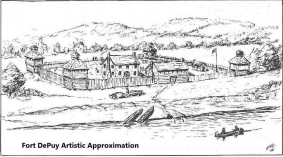
1725-1727 and purchased much land: first from the
Lanape, then again through the Penns. He developed a
prosperous plantation and lived in harmony with the
Lanape. By 1755 Indian relations had soured and many
homesteads were attacked as the French and Indian
War broke out. In 1755 the Depuy house was
stockaded as a fort by family and neighbors. It was
soon garrissoned with soldiers.
As Nicholas “the settler” was in his 70's, most war-time accounts report his son Samuel as head of the family. Military records describe a spring within the stockade and adequate accommodations for soldiers. The house had been much improved from the settler's original log house some 30 years earlier, was built of stone, but was never called a mansion. Another Nicholas was a teenager during the war. To clarify, below is the DePuys' direct line, significant to Shawnee:
Nicholas DePui c1625-1691 French Huguenot immigrant
Moses DePui c1657-1754 Ulster County NY
Nicholas DePuy 1682-1761 FIRST SHAWNEE SETTLER
Samuel DePuy 1716-1766 French & Indian War
Nicholas DePuy 1738-1808 Built Manwalamink 1785
Nicholas DePuy 1788-1816
Robert R. DePuy 1814-1898 last DePuy in Shawnee
In 1785 Samuel's son Nicholas built the mansion called Manwalamink near the fort's site. Since peace had prevailed for years, the stockade had likely been burned for firewood, and stones from the fort site were reused elsewhere.
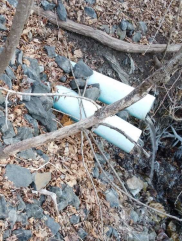
Today there are no signs of the old fort site, but the spring still flows, presently through a pipe passing under a gravel path. The spring is over 300 ft from Manwalamink.
Evidence of 2 Sites
1. The map at the top. This was produced for the state government specifically to locate frontier fort sites. 2. The spring location. It is unreasonable that a stockade could surround both Manwalamink and the spring. No other frontier forts were that large, and this one was built by farmers, not soldiers.
3. Prior to the 20th century, it was NEVER claimed that Manwalamink was the same house stockaded during the Indian war. These early references all indicate that it was not:
1886 Mathews, Alfred. H "Nicholas (2d) son of Samuel, built the stone house .. at Shawnee in 1785" 1895 Browning, Charles H. " and very near the present house of Robert DePui”
1896 Richards, H.M.M "It was about 200 ft. west by south of Mr. Robert Depuy's present farm house" 1925 Brodhead, Luke W. "... near the location of the present stone mansion"
1927 Keller, Robert Brown "near the original dwelling, was built by Robert R. De Puy's grandfather, Nicholas"
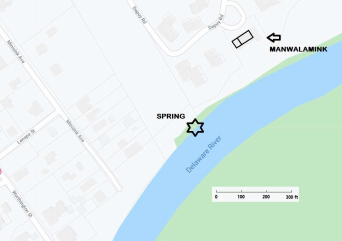
This article claims that Manwalamink was on the fort site, but also states that original features were put up in 1785. This could only be true if the "site" meant more of the DePuy lands, not just the stockade.
Misconception
By the early 21st Century almost everyone believed that Manwalamink was the Indian war house. All had heard this many times. It is easy to see the large building with this historic name and propagate the error. False assumptions could easily be made about Manwalamink since:
A. It was built by Nicholas DePuy as the family home. However, this Nicholas was the grandson of the first settler.
B. It has a small spring behind it. Much too small to support a garrison, especially in dry weather.
C. It has an iron fireback cast in 1746. These are portable, as it now sits in a room not built until 1907.
D. It sits on DePuy land along the river across from the upper island, just a little further upstream.
E. The DePuy family records were destroyed in Robert R. DePuy’s time, as he laments in H.M.M. Richards’ book.
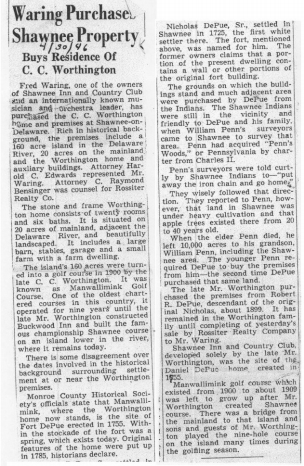
This ambiguity evolved into the common misunderstanding that Manwalamink existed in 1755 and was built by Nicholas Depuy, the first settler of Shawnee. Many historians erroneously propagate bad information. That is why the oldest records are the most reliable.
Acknowledgement: Thanks to Chris Francz for startling me about this.
References
Richards, H.M.M The Indian Forts of the Blue Mountains, Report of the Commission to Locate the Sites of the Frontier Forts of Pennsylvania, Vol 1, Clarence M. Busch, State Printer of PA 1896 pages 322-328 http://www.usgwarchives.net/pa/1pa/1picts/frontierforts/ff13.html
Brodhead, Luke W, "The 200th Anniversary of the Settlement of Shawnee" Monroe County Historical Society 1925
Browning, Charles H. The American Historical Register Sept 1894-Feb 1895, Philadelphia, the Historical Register Publishing Company p.529
Keller, Robert Brown, History of Monroe County PA, The Monroe Publishing Co 1927 p.23 https://digital.libraries.psu.edu/digital/collection/digitalbks2/id/18388/ Part_02
Mathews, Alfred. History of Wayne, Pike, and Monroe Counties, Pennsylvania 1938 R. T. Peck and Co. 1886 p. 1054 Sauvigne, Peter C. “DePui lineage related to Shawnee, PA” 2019 http://pete7a.com/DePuiFamilyShawnee.pdf
Manwalamink

~ 1898

“FORT DePUY” 2021
The following article was put up previously, and may not be correct with this new research from Pete Sauvigne.

Early years most dramatic
(Editor's Note: This is one of a weekly series by Bobby Westbrook on some of the historic places in this area, the people who built them and how the years have changed them - a countdown through 1975 toward the Bicentennial year of 1976.)
By Bobby Westbrook

To put things in perspective, those few troubled years were not the most important nor the most typical of life in the earliest settlement in this area, where peace, farming, trade and progress were keynotes. But they may well be the most dramatic.
 Thanks to research done by Russell Cramer II of Stroudsburg, the story of those troublesome times can be documented from state and military archives.

 However, it was Nicholas DePui who came and stayed and his imprint on the area was to make Shawnee at one time the center of trade and hospitality for the whole area.


 [Photo in paper, but not included here] Walk-in-fireplace - The fireplace in the oldest part of Fort DePui Lodge, half obscured by the black gas range, still shows traces of the oval bakeoven in the back.
 I show this Nicholas in my records as the following:
Buried - Presbyterian Church, Shawnee, Pennsylvania


Certainly the Indian troubles weren't the fault of the first settler, Nicholas DePui who lived with them in peace for many years.
Nicholas DePui, whose French Huguenot grandfather, also Nicholas, had come to the New World in 1662, and was born in Rochester, [Ulster] N. Y. It was in 1725 that, seeking a lost boy or a lost horese, he came down the Delaware River and found the fertile valley on the Pennsylvania side of the river.
Entranced by the prospect, he spent two years preparing the land and building a house before he brought his wife and their 10 children down from Rochester to settle on the banks of the Delaware in 1727.
It may be that white settlers had been before him on that site. Just three years later, in 1730, a team of surveyors sent out from Philadelphia made their way upstream.

"After a fatiguing journey, there being no white inhabitants in the upper part of Northampton Counties", after leading their horses with difficulty through the water gap, they came at last to the DePui plantation where they found "great hospitality and plenty of the necessaries of life".
They also found "a grove of apple trees of size far beyond any near Philadelphia." These may have been planted by the Dutch who worked the copper mines on the Jersey side of the river as early as 1654 and may have cultivated the land here before the Penn Charter.
 However, it was Nicholas DePui who came and stayed and his imprint on the area was to make Shawnee at one time the center of trade and hospitality for the whole area.
Nicholas DePui purchased the 3,000 acres of land from the Indians with Delaware chiefs signing the deed of Sept. 18, 1728. However, he found it necessary to repurchase the land from heirs of William Penn in 1733.

In the spacious stone house he built on the banks of the river, he was considered a friend by the Indians, who traded with him, sometimes sought his home as a refuge and some who worked on the plantation.
What sparked the Indian rebellion was the increasing pressure of English settlers coming up newly opened roads to the sough, frustrations arising from the Walking Purchase of 1737, the threat of the Iriquois -British coalition from the north. It all broke out locally when 200 Indians attacked the home of Daniel Broadhead in East Stroudsburg on Dec. 11, 1755.
In Shawnee, the settlers took the initiative in providing for their own protection, selecting the substantial house of Nicholas DePui and erecting around it a roomy stockade.
According to the Provincial Commissioners report of 1755, they found "The country all above this town is evacuated and ruined, excepting only the neighborhood of DePui's, five families which stand ground."


It was a square fort with swivel guns mounted at each corner, but, as an inspection report pointed out, "is open to attack from the hill above." On a navigable river, with its own spring within the stockade, where settlers later dipped their sheep, and well supplied their food, Fort DePui was named by Benjamin Franklin as a commissary base for all the Minisink area forts.
However, it was not Fort DePui but the neighboring home of Nicholas' son, Daniel, built about where Shawnee Inn now stands, which bore the brunt of a full-fledged Indian attack on Jan. 21, 1756.
Captain Salmare, stationed at nearby Fort Van Campen across the river, while scouting with his men on the New Jersey side, saw a fire over the river. "We crossed the river with 25 men", he reported, "and found upwards of 50 Indians attacking the house, who fled when they were fired upon." In Daniel's home he found two men killed, three wounded and 18 survivors. The Indians had burned the bard and fired the house in several places. They returned the next day and burnt the house but its inhabitants had found shelter.
Fort DePui, the home of Nicholas, was never attacked, whether because of his friendship with the Indians or the troops garrisoned there is pure conjecture. The soldiers were charged with protecting isolated farmers during their harvest. Attacks gradually tapered off and peace had returned by 1764.
 [Photo in paper, but not included here] Walk-in-fireplace - The fireplace in the oldest part of Fort DePui Lodge, half obscured by the black gas range, still shows traces of the oval bakeoven in the back.
[Top Photo in newspaper, but not included here] Present Fort DePui Lodge - The present Fort DePui Lodge of Shawnee Inn on the banks of the Delaware show the Victorian influence of C. C. Worthington, founder of Buckwood Inn and Golf Course, now Fred Waring's Shawnee Inn, in additions and gables. The original Fort DePui at the left, shows the small door in the first floor section, typical of the earliest houses in this area.
**Family Note: My Benjamin Depuy Junior served to defend this fort and lived here for one year.
Photos included here were found at www.bedandbreakfast.com
MORE NOTES BY ALLYSON:
 I show this Nicholas in my records as the following:
Nicolaes Dupuy, born 12 Mar 1701, Kingston, Ulster, New York.
Christening: 3 Dec 1682, Kingston Church, Ulster, New York
Died - 1761, Lower Pocono Mountains, PennsylvaniaBuried - Presbyterian Church, Shawnee, Pennsylvania
wife: Wyntje Roosa
born in Hurley, Ulster and christened 4 Jun 1682 Kingston, Ulster, New York
died 1760.
My relationship: Nicolaes is a brother to Moses Jr, making him an uncle to my Benjamin Sr.
My Benjamin Jr. lived in the fort for one year while serving in the military.
Source of Photos: taken by and of Allyson Hunt Wood and Marsha Lockerby Pilger, 2010 trip to "Uncle Nicholas's"
Source of Photos: taken by and of Allyson Hunt Wood and Marsha Lockerby Pilger, 2010 trip to "Uncle Nicholas's"


Friday, April 9, 2010
Fort Depuy in Shawnee, PA

Previously thought to be a part of the original fort from the Revolutionary war but the preceding article shows that cannot be possible.
Shared by Jackie Depuy Banahan,
Thursday, April 8, 2010
John Depuy 1830
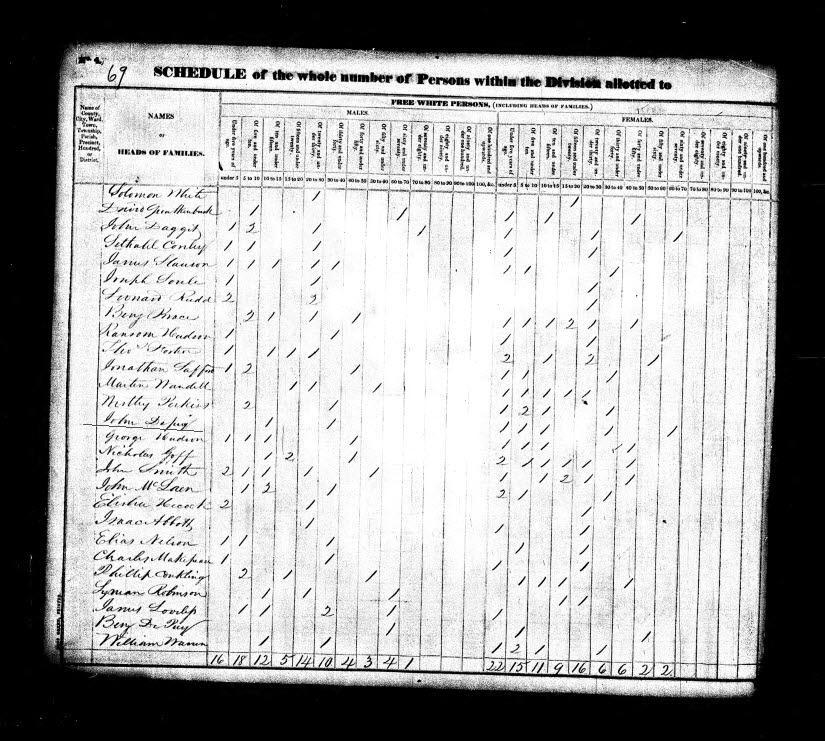
In Lysander, Onondaga, New York.
John 30-40,
Lucy 30-40,
Elizabeth Story Depuy 6,
Philena Arena 2,
?1 female 60-70
? 1 female 15-20


David Canfield 1850
 The David Canfield family was found in Provo, Utah County, Utah in 1850. They enjoyed about 11 years in that beautiful area before moving to Utah's Dixie.


Elizabeth Story Depuy Canfield 1900
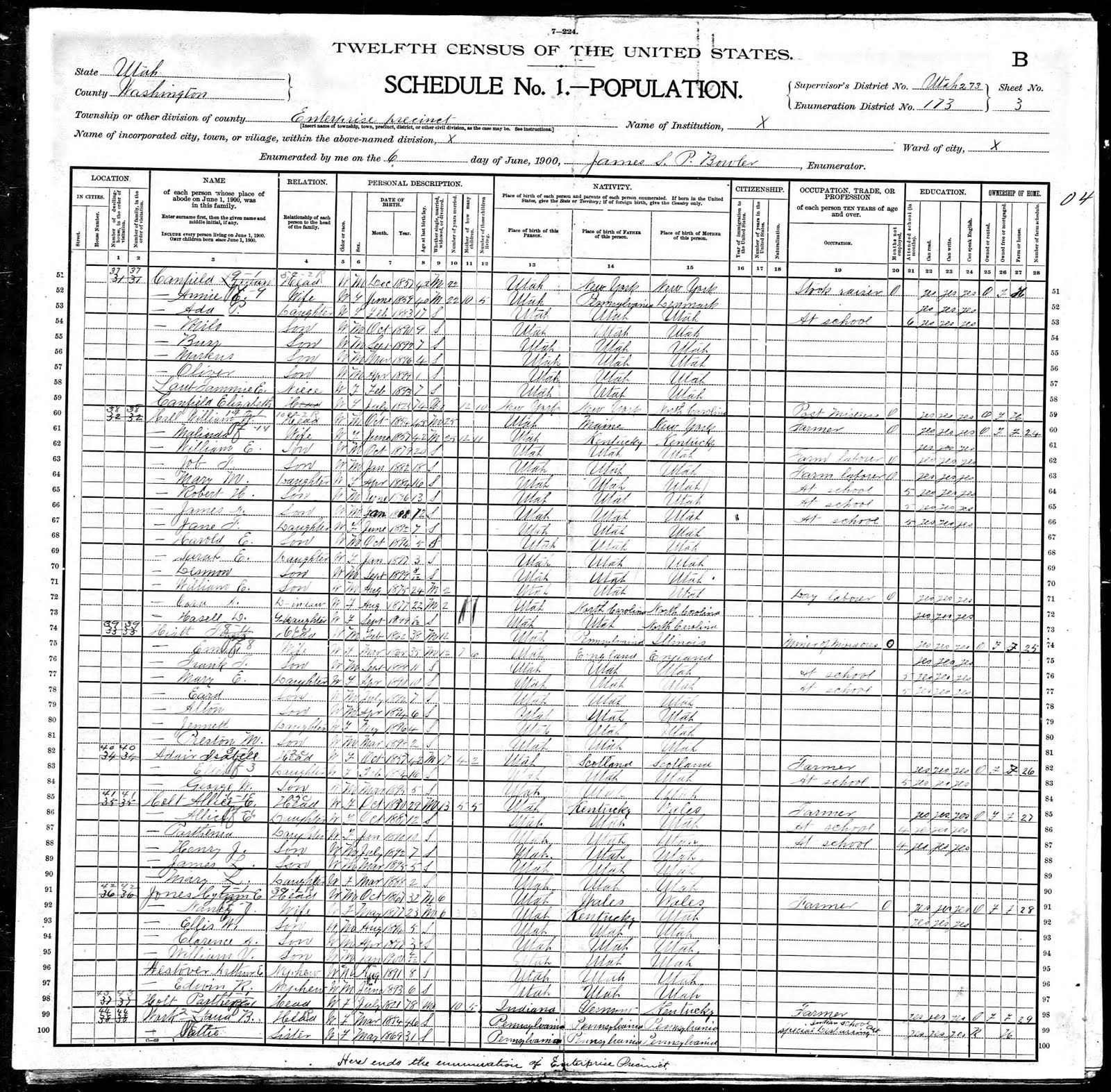
After David passed away, Elizabeth continued living in her home until her final few years. She moved to Enterprise, Washington County, Utah and lived with a couple of her sons.
Ben Depuy Jr and Arena's Cemetery Record

Benjamin Depuy Jr and his wife Arriantia (Arena) Van Auken were buried in the Riverview Cemetery, near Baldwinsville, Onondaga, New York.
The green hearts are next to our family members buried in that cemetery.
Ben Depuy Jr. Alternate Birth date

In the Pension Records of the Revolutionary Soldiers, Benjamin reports that his birth date is Dec 29, 1764.
Church records in Rochester, show that Benjamin was christened 2 Nov 1758. I have tried to figure out the discrepancy on birth dates, but have not discovered any clues.


Subscribe to:
Posts (Atom)