Saturday, April 10, 2010

Shawnee-on-Delaware - Nicholas DePui / Depuy

Fort DePuy Location  

January 25, 2021 by Pete Sauvigne http://pete7a.com/fort.pdf  

Shared with Permission July 12, 2021

Summary  

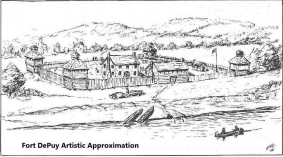
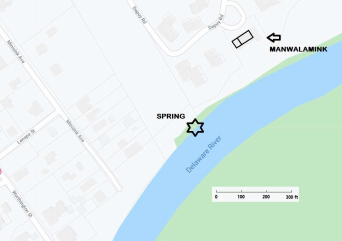
The DePuy home was stockaded and garrissoned as a fort during the French and Indian War 1755-1763. However the  building we know as Fort DePuy did not exist until after the war, and is about 200 feet outside the old stockade, which  no longer exists. The present building, long known as Manwalamink, was built in 1785 by a later Nicholas DePuy. Below  is a 1896 map showing the relative locations of the old fort and Manwalamink, labelled as Robert DePui's house. 


Until the 20th century, it was never claimed that Manwalamink was within the stockaded fort. The Worthington family  never claimed that. However, after the mid 1900’s it became common belief that Manwalamink was the old fort. “Fort  DePuy” remains another fine name for the structure, to commemorate the events that occurred nearby.  

History  

Nicholas DePuy (1682-1761) was the first permanent European settler of the lower Minisink area. His grandfather, also  named Nicholas DePuy was a French Heugenot refugee who landed in Dutch New Amsterdam (now NYC) in 1662.  Nicholas “the settler” first built a log house in Shawnee  
1725-1727 and purchased much land: first from the  

Lanape, then again through the Penns. He developed a  

prosperous plantation and lived in harmony with the  

Lanape. By 1755 Indian relations had soured and many  

homesteads were attacked as the French and Indian  

War broke out. In 1755 the Depuy house was  

stockaded as a fort by family and neighbors. It was  

soon garrissoned with soldiers. 


As Nicholas “the settler” was in his 70's, most war-time accounts report his son Samuel as head of the family. Military  records describe a spring within the stockade and adequate accommodations for soldiers. The house had been much  improved from the settler's original log house some 30 years earlier, was built of stone, but was never called a mansion.  Another Nicholas was a teenager during the war. To clarify, below is the DePuys' direct line, significant to Shawnee:  

Nicholas DePui c1625-1691 French Huguenot immigrant  

Moses DePui c1657-1754 Ulster County NY  

Nicholas DePuy 1682-1761 FIRST SHAWNEE SETTLER 

Samuel DePuy 1716-1766 French & Indian War  

Nicholas DePuy 1738-1808 Built Manwalamink 1785  

Nicholas DePuy 1788-1816  

Robert R. DePuy 1814-1898 last DePuy in Shawnee  

In 1785 Samuel's son Nicholas built the mansion called Manwalamink near the fort's site. Since peace had prevailed for  years, the stockade had likely been burned for firewood, and stones from the fort site were reused elsewhere.    

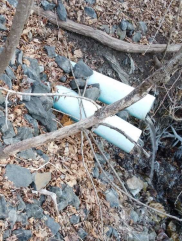
Today there are no signs of the old fort site, but the spring still flows, presently through a pipe passing under a gravel  path. The spring is over 300 ft from Manwalamink.  

Evidence of 2 Sites  

1. The map at the top. This was produced for the state government specifically to locate frontier fort sites. 2. The spring location. It is unreasonable that a stockade could surround both Manwalamink and the spring. No other  frontier forts were that large, and this one was built by farmers, not soldiers.  
3. Prior to the 20th century, it was NEVER claimed that Manwalamink was the same house stockaded during the Indian  war. These early references all indicate that it was not:  

 1886 Mathews, Alfred. H "Nicholas (2d) son of Samuel, built the stone house .. at Shawnee in 1785"   1895 Browning, Charles H. " and very near the present house of Robert DePui”  

 1896 Richards, H.M.M "It was about 200 ft. west by south of Mr. Robert Depuy's present farm house"   1925 Brodhead, Luke W. "... near the location of the present stone mansion"  

 1927 Keller, Robert Brown "near the original dwelling, was built by Robert R. De Puy's grandfather, Nicholas" 

This article claims that Manwalamink was on the fort site, but also states that original features were put up in 1785. This could only be true if  the "site" meant more of the DePuy lands, not just the stockade.  


Misconception  


By the early 21st Century almost everyone believed that Manwalamink was the Indian war house. All had heard this  many times. It is easy to see the large building with this historic name and propagate the error. False assumptions could  easily be made about Manwalamink since:  


A. It was built by Nicholas DePuy as the family home. However, this Nicholas was the grandson of the first settler. 

B. It has a small spring behind it. Much too small to support a garrison, especially in dry weather. 

C. It has an iron fireback cast in 1746. These are portable, as it now sits in a room not built until 1907. 

D. It sits on DePuy land along the river across from the upper island, just a little further upstream. 

E. The DePuy family records were destroyed in Robert R. DePuy’s time, as he laments in H.M.M. Richards’ book.  
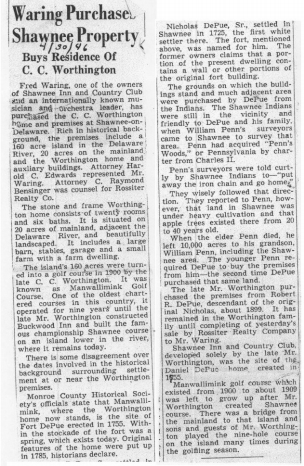
The first reference yet found that implies that Manwalamink was on the fort site is from a 1946 newspaper article:

This ambiguity evolved into the common  misunderstanding that Manwalamink existed in  1755 and was built by Nicholas Depuy, the first  settler of Shawnee.  Many historians erroneously propagate bad  information. That is why the oldest records are the most reliable. 


Acknowledgement: Thanks to Chris Francz for startling me about this.  


References  

Richards, H.M.M The Indian Forts of the Blue Mountains, Report of the Commission to Locate the Sites of the Frontier  Forts of Pennsylvania, Vol 1, Clarence M. Busch, State Printer of PA 1896 pages 322-328  http://www.usgwarchives.net/pa/1pa/1picts/frontierforts/ff13.html 

Brodhead, Luke W, "The 200th Anniversary of the Settlement of Shawnee" Monroe County Historical Society 1925  

Browning, Charles H. The American Historical Register Sept 1894-Feb 1895, Philadelphia, the Historical Register  Publishing Company p.529  

Keller, Robert Brown, History of Monroe County PA, The Monroe Publishing Co 1927 p.23  https://digital.libraries.psu.edu/digital/collection/digitalbks2/id/18388/ Part_02  

Mathews, Alfred. History of Wayne, Pike, and Monroe Counties, Pennsylvania 1938 R. T. Peck and Co. 1886 p. 1054 Sauvigne, Peter C. “DePui lineage related to Shawnee, PA” 2019 http://pete7a.com/DePuiFamilyShawnee.pdf  

Manwalamink  

 ~ 1898  


“FORT DePUY”  2021


The following article was put up previously, and may not be correct with this new research from Pete Sauvigne.  


The Poco
..... [Newspaper] Vol. 81, No 240: The Stroudsburgs, PA: [my copy came from correspondence and I do not have date [ 1975], nor full name of the paper. Typed without original newspaper format]

The past is prologue

Early years most dramatic

(Editor's Note: This is one of a weekly series by Bobby Westbrook on some of the historic places in this area, the people who built them and how the years have changed them - a countdown through 1975 toward the Bicentennial year of 1976.)

By Bobby Westbrook
SHAWNEE-On-DELAWARE -- Those who like their American history stereotyped with accounts of Indian raids on frontier forts can find plenty of authenticated material centering around Fort DePui. On its site now stands the lodge for overflow guests from Shawnee Inn behind the Fred Waring home in the village.

To put things in perspective, those few troubled years were not the most important nor the most typical of life in the earliest settlement in this area, where peace, farming, trade and progress were keynotes. But they may well be the most dramatic.
Thanks to research done by Russell Cramer II of Stroudsburg, the story of those troublesome times can be documented from state and military archives.

Certainly the Indian troubles weren't the fault of the first settler, Nicholas DePui who lived with them in peace for many years.

Nicholas DePui, whose French Huguenot grandfather, also Nicholas, had come to the New World in 1662, and was born in Rochester, [Ulster] N. Y. It was in 1725 that, seeking a lost boy or a lost horese, he came down the Delaware River and found the fertile valley on the Pennsylvania side of the river.

Entranced by the prospect, he spent two years preparing the land and building a house before he brought his wife and their 10 children down from Rochester to settle on the banks of the Delaware in 1727.

It may be that white settlers had been before him on that site. Just three years later, in 1730, a team of surveyors sent out from Philadelphia made their way upstream.


"After a fatiguing journey, there being no white inhabitants in the upper part of Northampton Counties", after leading their horses with difficulty through the water gap, they came at last to the DePui plantation where they found "great hospitality and plenty of the necessaries of life".


They also found "a grove of apple trees of size far beyond any near Philadelphia." These may have been planted by the Dutch who worked the copper mines on the Jersey side of the river as early as 1654 and may have cultivated the land here before the Penn Charter.


However, it was Nicholas DePui who came and stayed and his imprint on the area was to make Shawnee at one time the center of trade and hospitality for the whole area.


Nicholas DePui purchased the 3,000 acres of land from the Indians with Delaware chiefs signing the deed of Sept. 18, 1728. However, he found it necessary to repurchase the land from heirs of William Penn in 1733.


In the spacious stone house he built on the banks of the river, he was considered a friend by the Indians, who traded with him, sometimes sought his home as a refuge and some who worked on the plantation.

What sparked the Indian rebellion was the increasing pressure of English settlers coming up newly opened roads to the sough, frustrations arising from the Walking Purchase of 1737, the threat of the Iriquois -British coalition from the north. It all broke out locally when 200 Indians attacked the home of Daniel Broadhead in East Stroudsburg on Dec. 11, 1755.

In Shawnee, the settlers took the initiative in providing for their own protection, selecting the substantial house of Nicholas DePui and erecting around it a roomy stockade.

According to the Provincial Commissioners report of 1755, they found "The country all above this town is evacuated and ruined, excepting only the neighborhood of DePui's, five families which stand ground."

It was a square fort with swivel guns mounted at each corner, but, as an inspection report pointed out, "is open to attack from the hill above." On a navigable river, with its own spring within the stockade, where settlers later dipped their sheep, and well supplied their food, Fort DePui was named by Benjamin Franklin as a commissary base for all the Minisink area forts.

However, it was not Fort DePui but the neighboring home of Nicholas' son, Daniel, built about where Shawnee Inn now stands, which bore the brunt of a full-fledged Indian attack on Jan. 21, 1756.

Captain Salmare, stationed at nearby Fort Van Campen across the river, while scouting with his men on the New Jersey side, saw a fire over the river. "We crossed the river with 25 men", he reported, "and found upwards of 50 Indians attacking the house, who fled when they were fired upon." In Daniel's home he found two men killed, three wounded and 18 survivors. The Indians had burned the bard and fired the house in several places. They returned the next day and burnt the house but its inhabitants had found shelter.

Fort DePui, the home of Nicholas, was never attacked, whether because of his friendship with the Indians or the troops garrisoned there is pure conjecture. The soldiers were charged with protecting isolated farmers during their harvest. Attacks gradually tapered off and peace had returned by 1764.

[Photo in paper, but not included here] Walk-in-fireplace - The fireplace in the oldest part of Fort DePui Lodge, half obscured by the black gas range, still shows traces of the oval bakeoven in the back.

[Top Photo in newspaper, but not included here] Present Fort DePui Lodge - The present Fort DePui Lodge of Shawnee Inn on the banks of the Delaware show the Victorian influence of C. C. Worthington, founder of Buckwood Inn and Golf Course, now Fred Waring's Shawnee Inn, in additions and gables. The original Fort DePui at the left, shows the small door in the first floor section, typical of the earliest houses in this area.

 **Family Note: My Benjamin Depuy Junior served to defend this fort and lived here for one year.

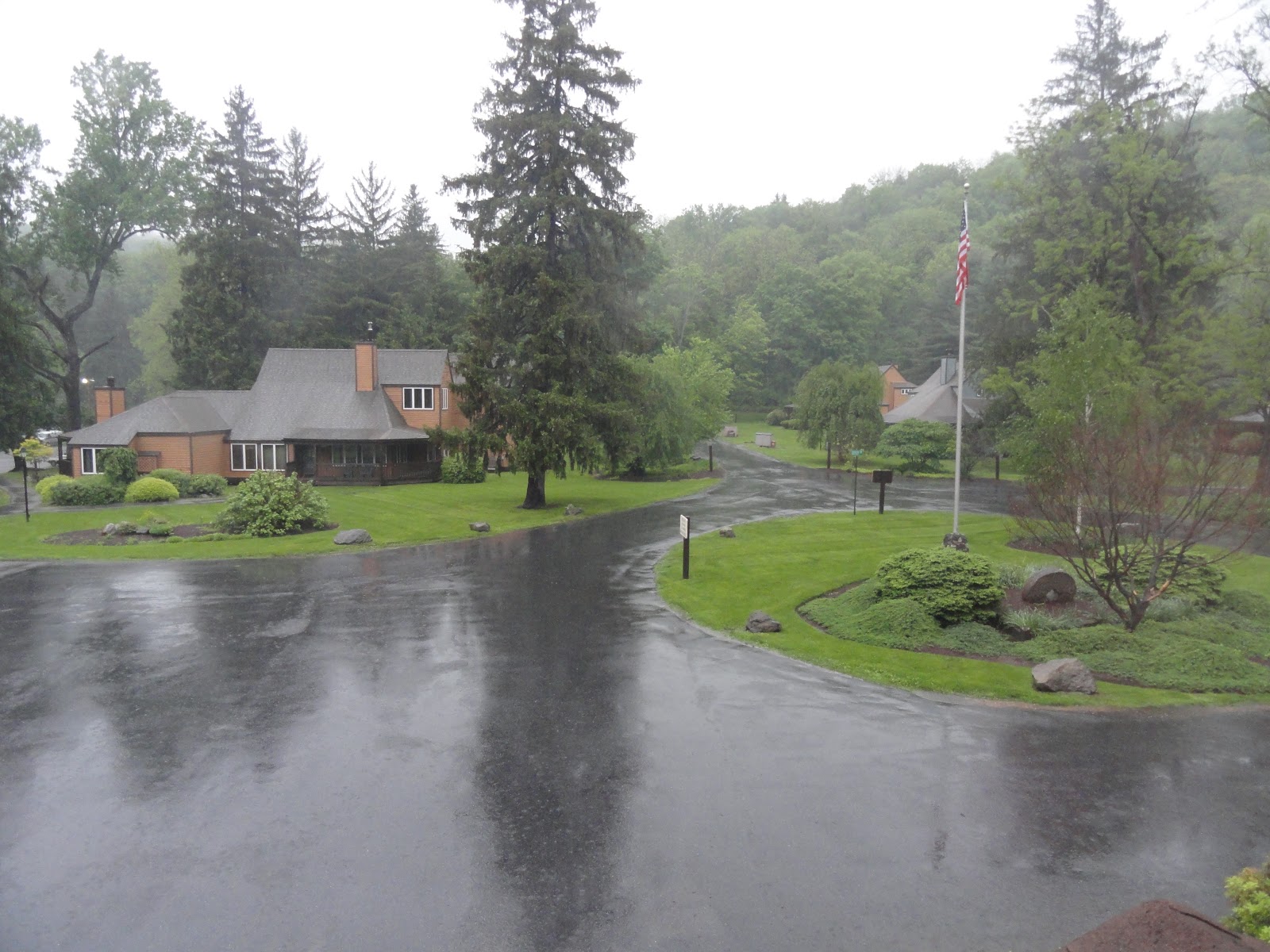
Photos included here were found at www.bedandbreakfast.com

MORE NOTES BY ALLYSON:

I show this Nicholas in my records as the following:

Nicolaes Dupuy, born 12 Mar 1701, Kingston, Ulster, New York.
  Christening: 3 Dec 1682, Kingston Church, Ulster, New York
   Died - 1761, Lower Pocono Mountains, Pennsylvania
   Buried - Presbyterian Church, Shawnee, Pennsylvania

wife: Wyntje Roosa
  born in Hurley, Ulster and christened 4 Jun 1682 Kingston, Ulster, New York
  died 1760.

My relationship: Nicolaes is a brother to Moses Jr, making him an uncle to my Benjamin Sr.
My Benjamin Jr. lived in the fort for one year while serving in the military.
Source of Photos:  taken by and of Allyson Hunt Wood and Marsha Lockerby Pilger, 2010 trip to "Uncle Nicholas's"


Friday, April 9, 2010

Fort Depuy in Shawnee, PA


Previously thought to be a part of the original fort from the Revolutionary war but the preceding article shows that cannot be possible.

Shared by Jackie Depuy Banahan, 


Thursday, April 8, 2010

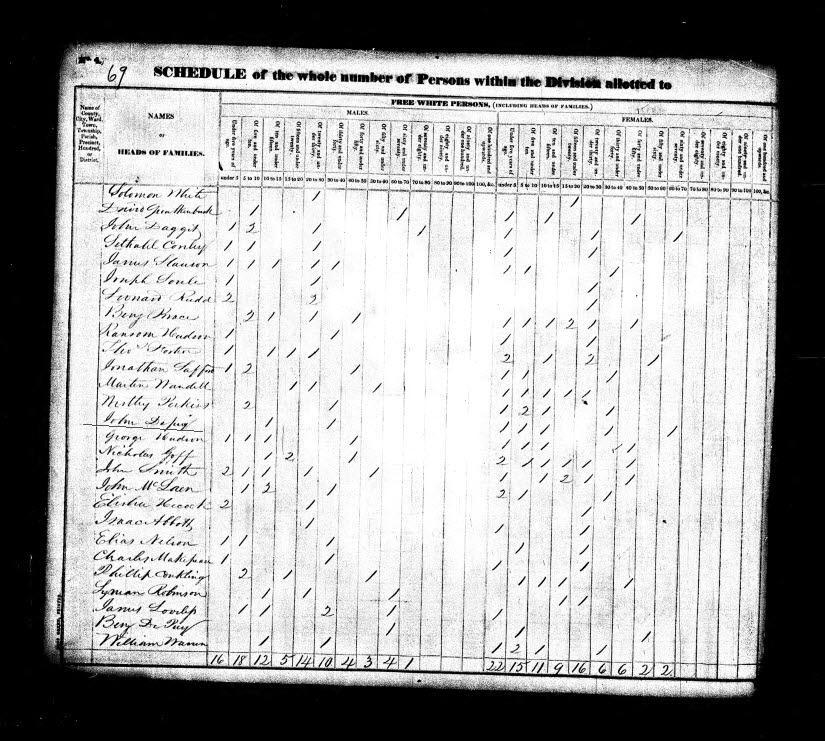
John Depuy 1830


In Lysander, Onondaga, New York.
John 30-40,
Lucy 30-40,
Elizabeth Story Depuy 6,
Philena Arena 2,

?1 female 60-70
? 1 female 15-20

David Canfield


Photo of David Canfield and the funeral remembrance at his passing.

David Canfield 1840

David Canfield 1850

The David Canfield family was found in Provo, Utah County, Utah in 1850. They enjoyed about 11 years in that beautiful area before moving to Utah's Dixie.

David Canfield 1860


Pine Valley, Washington County, Utah in 1860.

David Canfield 1870

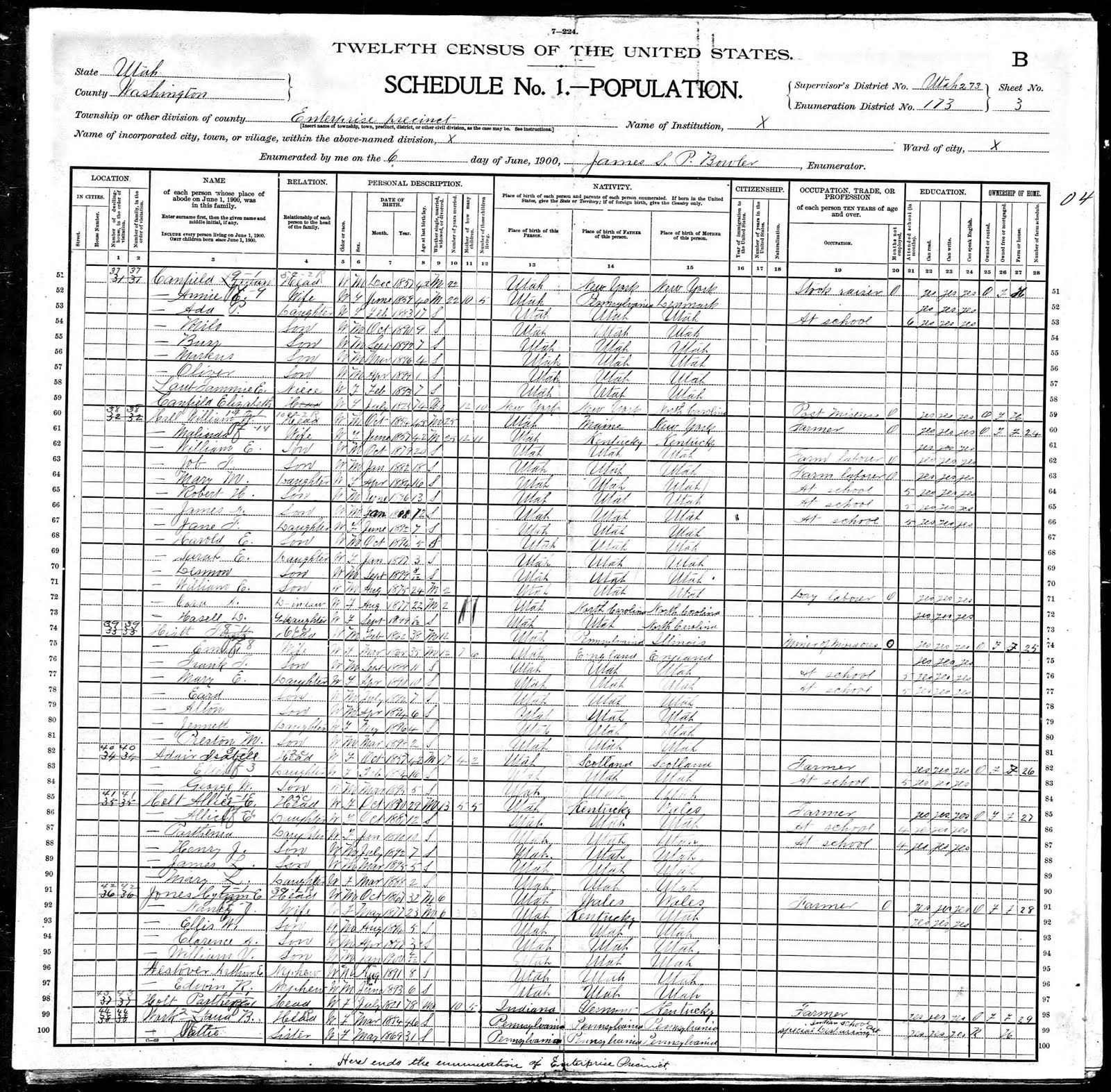
Elizabeth Story Depuy Canfield 1900


After David passed away, Elizabeth continued living in her home until her final few years. She moved to Enterprise, Washington County, Utah and lived with a couple of her sons.

Ben Depuy Jr and Arena's Cemetery Record


Benjamin Depuy Jr and his wife Arriantia (Arena) Van Auken were buried in the Riverview Cemetery, near Baldwinsville, Onondaga, New York.

The green hearts are next to our family members buried in that cemetery.

Ben Depuy Jr. Alternate Birth date


In the Pension Records of the Revolutionary Soldiers, Benjamin reports that his birth date is Dec 29, 1764.

Church records in Rochester, show that Benjamin was christened 2 Nov 1758. I have tried to figure out the discrepancy on birth dates, but have not discovered any clues.

Surrogate Court Record Cayuga for Ben Depuy


Oath of Allegience

The "Oath of Allegiance" to the King of Great Britain, signed by Benjamin De puy, Sr.

Friday, March 5, 2010

David Canfield and Elizabeth Story Depew Canfield

Paternal Grandparents
by James Willard Canfield

My paternal grandfather, David Canfield, was born on May 9, 1812, in Gorham (Ontario County), New York, the son of James Canfield and Susanna Blake Canfield. Not much is known about his childhood, youth and early manhood. A brief reference indicated that he moved to Toronto, Canada, and married an Irish girl, Sally Mathison, about 1833. Two children were born in Candada, but no information is available as to what happend to this marriage and the two daughters, Jane and Susanna. [Preston Hunt later researched this line and has more information on this little family]. He joined the Church of Jesus Christ of Latter-day Saints in 1836. (It is possible that his conversion to the Mormon religion caused a divorce; this is mere conjecture on my part). Reliable data indicates that he came back to the United States and was baptized in 1843 by Parley P. Pratt.
He was married to my grandmother, Elizabeth Story Depew, on October 1, 1843, but records are not clear as to where they were married. She was the daughter of John Horace Depew and Lucy Lonsberre Roberts Depew, and was born on July 10, 1825, in Lysander, New York. The first of their ten children, David Jr., was born July 25, 1844, in Defiance, Ohio, and Ellen Elizabeth was born on April 1, 1846, in Chicago, Illinois, followed by Moroni on February 5, 1848.
Grandfather went to Nauvoo in 1845 and helped to finish up the Temple as far as it was completed. My grandparents did not join the first movement to Utah, but came there in 1850 and settled in Provo where my father, James Canfield, was born on October 9, 1850. The next five children were also born in Provo: Lucy Philena, January 21, 1853; Parley Pratt, July 24, 1855; Lyman, December 19, 1857; Harriet Alma, April 5, 1859 (died in infancy); and Clara, November 12, 1861. Their tenth child, Alice Lillian (Aunt Allie), was born in Pine Valley, Utah, on October 28, 1864.
At the beginning of the Civil War, Brigham Young was afraid that Utah would not be able to secure cotton, and knew that southern Utah, because of the climate and productive land, was suitable to grow cotton. This was the pirmary purpose of colonizing St. George. Men of various occupations were selected to insure a resourceful personnel, and David Canfield, who was a skilled carpenter, was called. The family moved to St. George and Grandfather helped build the Jacob Hamblin home in Santa Clara, Utah, late in 1861. He also did considerable work on the St. George Temple which was the first temple finished by the Mormons in Utah.
While I can state with some conviction that my grandparents were obedient Church members and came to southern Utah because they were so ordered by the Church authorities, they were a bit resentful that they lost their fine property acquired in Provo. Evidently Grandfather resented the continual control of local Church authorities, because he moved his family to a place called "The Foster Ranch" on the Santa Clara River, twenty-four miles north of St. George before 1864, where they raised fruit, vegetables and a few cattle. Sometime in the late sixties they moved to Hamblin, utah, their last home, and where I entered the picture and my first memories began.
Grandfather was a big man; he stood over six feet and weighed better than 200 pounds. He was quiet spoken and an agreeable, non-aggressive neighbor, From Father I later acquired the information that Grandfather had been very active in all physical activities. Father told me that at one time Grandfather walked from St. George to their dwelling on the Santa Clara Creek, a distance over twenty miles, carrying a huge brass kettle.
I remember Grandfather best as he sat in the big rocker, which he had constructed, and read the paper and smoked his corn cob pipe. Although the Mormon Church considered the use of tabacco an evil, Grandfather had acquired the habit before he joined the Church and found considerable comfort smoking his pipe. The tobacco was cut from a plug or roll of tobacco leaf, on a pine board made for that purpose. On one occasion, mary Sinfield, a neighbor my age, and I sat on the floor close to Grandfather's chair. We picked up small portions of the tobacco that occasionally fell when being cut, and ate the same. It had a sweet flavor; I presume it had been flavored. The out-come was that I became violently ill and lost my dinner, while the tough girl Mary weathered the experience without illness.
During the year of 1896, when he was in his eighty-fourth year, I remember that Grandfather Canfield was quite inactive. His physical activity consisted of chopping wood, and building fires around the outdoor kettle used for heating water for washing clothes and cooking food for the pigs. The pig pens at the back of the lot were of interest to me because of the litter of young pigs that frequently came in the springtime, and I helped when some of the pink-nose squealling midgets escaped from the pen through cracks in the logs and then had trboule finding their way back. The pigs were fed quantities of green weeks, green alfalfa, and cooked potatoes and wheat. The huge brass outdoor kettle would be filled with a mixture of small potatoes (culled out when picked in the fall and placed in a separate cellar) and wheat. The children were not opposed to dipping out a few clean potatoes and a cup of well cooked wheat and eating the same. We relished the dish when mixed with good milk and molasses; the molasses was obtained from Utah's Dixie where it was made from sugar cane.
The slaughtering of beef and pigs was supervised by Granfather Canfield. Beek was killed in the winter time when it could be frozen and hung high on the north side of the house. Pigs were raised for fresh meat and cured side bacon and hams which, when placed in large oak barrels in a strong salt solution for several weeks and then hung up to dry, would keep over the summer.
I remember once watching Grandfather as he gathered an armful of wood to carry to the back porch and I was alarmed when he stumbled over the chopping block and fell. He did not move for a moment or two and then could not get up. I ran for Grandmother; she, in turn, called for Father who came to Granfather's assistance. his last illness of four weeks was severe, but he bore this suffering patiently and went to his rest in Hamblin on May 8, 1897, leaving a record of a man who never failed to respond to the call of God's servants and who was ever true to the trust reposed in him.
In many respects, Grandmother Canfield was a stronger character than Grandfather. She was a medium sized women with a tremendous amount of mental and physical energy. She was neat and attractive, with a pleasing manner thant endeared her to all close friends and accosicates, and attracted frquent visitors. For years travelers stopped at her place for meals and lodging. The number that could be served was restricted to four or five because of lack of sleeping accomodations, but any larger groups were the exception in those days. After the railroads reached Modena, Utah, most of the freight and passenger service from St. George and vicinity came through Hamblin and Granmother sold hay and grain for the stage and freight teams. This of course provided extra pennies and she was thrifty. By saving over a period of time she accumulated enough for her to take the train to the Chicago World Fair in 1893. I cannot remember the event, but many times later I listed to her accounts of what she saw and who she met in Chicago. The bi-weekly mail occasionally brought newspapers and letters from her former home.
Grandmother was intelligent and resourceful. For years she was the post-mistress of Hamblin. Grandpa built her a carpet loom and every year or so it was put up in the north end of the long kitchen and new rugs and carpets were woven. All pieces of good cloth were saved, and sometimes colored to add to the artistic effect. Mother went there frequently to help and also fashion one to her liking.
They also made candles from tallow which were used especially in the three bedrooms. Grandfather made a cheese press which sat out by the porch, and I remember the cheese making process. Aunt Libby Canfield, Uncle Lyman's wife, fell heir to the press and made cheese and occasionally sold some of it. I learned to milk cows at five years of age, but my small hands seemed to be capable of milking only two cows each morning and evening.
After we moved from hablin I frequently would spend two or three days with Grandmother. She was quite proud of her maiden name, Depew, but I cannot recall her genealogy background. (However, I have always been of the opinion that Chauncy M. Depew, the lawyer nd famous after-dinner speaker, was a close relative). Grandmother Canfield died on June 5, 1908, in Cedar City and was buried in Hamblin.

Friday, February 19, 2010

Esther Elizabeth Barnum Emett Death Certificate


Esther is the wife of David Carlos Emett, son of David Canfield and Elizabeth Story Depuy, and grandson of John Depuy and Lucy Lonsberre Roberts.

Fort Depuy, Pennsylvania


Parley Pratt Canfield death record


Death certificate from the state of Utah for Parley Pratt Canfield, son of David Canfield and Elizabeth Story Depuy, and grandson of John Depuy and Lucy Lonsberre Roberts.

I was not able to find the certificate of Parley's wife Laura Marie Westover.

Lyman Canfield & Anna Elizabeth Laub


Death certificates from the state of Utah for Lyman Canfield and his wife Anna Elizabeth Laub. Lyman is the son of David Canfield and Elizabeth Story Depuy, and grandson of John Depuy and Lucy Lonsberre Roberts.

Moses Franklin Farnsworth & Clara Canfield


Death certificates from Utah for Moses Franklin Farnsworth and his wife Clara Canfield. Clara is the daughter of David Canfield and Elizabeth Story Depuy, and granddaughter of John Depuy and Lucy Lonsberre Roberts.

Benjamin Franklin Knell & Alice Lillian Canfield

Death Certificates from Utah for Alice Lillian Canfield, daughter of David Canfield and Elizabeth Story Depuy. Alice Lillian is the granddaughter of John Depuy and Lucy Lonsberre Robert.

New Jersey Claim Line


Photo - thanks to Minisink Valley Historical Society

Friday, February 5, 2010

1790 Mamakating, Ulster, NY Census


Benjamin Depuy Jr. and Arriaantia Van Auken
Series M637, Roll 6
Page 175, (#91)
Mamakating, Ulster, New York, USA
(interpretation: Moses - age 3
Elias - age 1 (must have died)
....................
Benjamin Depuy Sr. and Elizabeth Swartout
Series M637, Roll 6
Page 176, (#101)
Mamakating, Ulster, New York, USA

John Depuy


Born Dec 1, 1798 and christened June 15, 1799. Son of Benjamin Depuy Jr. and Arrietta (Americanized to Arena) V(an) Auken. Record from Owasco, New York.

Thursday, February 4, 2010

Fort Gumaer, Fort Depuy


Photos taken by Marsha Lockerby Pilger 2009

(the following letter source: LDSFHL#0931482, 0931483 Misc file of Ulster County, NY)

... I will try to give you a discription of the old DePuy house, and the furnitions in it.
The cellar entrance you speak of was the basement, where there was a very large room and bedroom off for slaves, as well as outside slave quarters. The slaves were all freed very early but some stayed on for wages, and they are Mark Depuy to this day about the country.
In that old kitchen was an immense fireplace, with old __(crane?)__, iron forte and kettel and old tip table and side hand with pewter and old dishes. The stair rail was worn by their dear old hands and the steps were so worn it was rather difficult to come down them as they were slippery and where the old rails were high up. The stairs had a lovely turn as it landed on the first floor at the head of the hall, near an old half door with wonderful lock and hinges. This room led to the lean-to you speak of which was always called the back porch. It had a fine corner closet with old dishes where platters set and another old house, they called it. It was used for summer dinning room, never for milk (milking?) cows (?) as that was all done at the farmers house at the east of the old road, now about abandoned, since the back road was made a state road, what is now the state road, was only a road through the woods.

Entering the front door, comes on right and left, a long hall runing through the house. In the hall and old lantern with candle in it hung. A beautiful mahogony table to one side, beautiful old stairs with turn and landing.
At the left a large living room in later years the back part a bedroom, first a wooden partition. Lovely old glass bureau, rocking chair, tripod (?) table, and the dearest little wood stove, made like a house with gables on it, and shovel, thongs and poker of iron.
The parlor at the right had a handsome table, old lampe and various quaint old ornaments; beautiful mirror of gilt with a scounce; magnifcent old desk of mahogony with inland work and collums; and beautiful chair.
The little black bedroom had a four poster bed with ___ and straw and feather bed. Old fireplace with chimney cupboards filled with old glassware, dishes, pewter, and many quaint things. The fireplace had been closed with a board covered with the most wonderful old paper which I used to study when a child. There was and old stove for wood that reguladed itself by - steel cord (?) -- that closed the draft when the wood expanded with heat and opened it when it cooled and contracted. At the extreme east side of the room, or rather south east, there was a door leading to a small hall and an side entrance with transome, the half door you saw. There was a large pantry at the end of hall, and secretary in the corner. From that small hall a door led to the back bedroom which had a four poster bed, with curtains. A fine mirror, a little washstand with hold in the top for the lovely blue bowl and pitcher, the temple pattern (which I have now); a fine bureau, a fireplace, also ____ with firewood; and cupboard at side of the chimney; every closet had china in it.

The choice piece of furniture was in the back bedroom. An old ____, with tall leggs; a wonderful old cabinet with drawers beneath; a very large piece of furniture.
The second floor had a double bedroom on the north end with four poster beds at each side; a piece for each sister to keep her belongings; a ___ sewing table like an hour glass with a sewing ______; a closet filled with old dresses, jackets etc. Between the windows hung a Washington mirror; a little wash stand with a Lafayette bowl and pitcher. beautiful blue, a sceane of LaFayette landing at castle garden in 1824. I have these, also the mirror ____ and many other things.

The south end of the second story was also a bedroom with an attic return and another small room at the end of the hall filled with all the wooden things they used in making flax into linen. I have the sheets, pillowcases, out of the linen made in the place as well as garmets way back to my grt-grt-grt- grandmother with her initials and those of the grand-daughter she gave them to. Linen stockings; wollen blankets with strange yarn corners and many many other things. Even a powder box and puff.

The Markel house on the hill was a DePuy house, but much larger. This man tore down more than half of the house and sold the stone. In fact all the places about these once belonged to the DePuy estate of 640 acres. I have a _____carved by the Indians and given to my ____great grandmother by them because she had always been good to them, and the original DePuy had paid them well for their land, so they were always friendly. There had never been another owner until now and the land had never been mortgaged.

The old house was build where it was because of the excellent spring, but not a very good _____. The Ephriam DePuy place on the old stage road (at the east of the place the main road until lately) a couple of miles north, was an elegant old place. Very large stone house; two stories and half high; fine other building and a beautiful situation standing high from the road and west of the road. Fallen down now.

Arther Emdorfel (?) old house is the large stone house in Stone Ride, where Washington spent a night and the bedroom was always left as he left it, with bed unmade, as he got out of it in the morning. Lovely old tile fireplace, the tiles were brought from Holland. It was owned long ago by a Wynkoop, one of our family, and inlaw married with Lounbery (?) a descendant still living there. William Lonsbury. It is opposite the old Nancy (?) Tack Inn, which was enlarged and rebuilt ____ place.

The old DePuy home that burned was b ack to the northwest of the Markle houses, the foundation was still there when I was a child. I know nothing of the Rest Place. My grandfather Schoonmaker might have. It may be near Rosendale, that was more Dutch in that _______.
If mother and even aunt Katherine had only reckoned to the interest of these things earlier, Aunt Helena, an older sister of Katherines knew all the families about there, and my grandfather Schoonmaker, too, who could speak Dutch, he, as a very young man fought in the war of 1812.
Hoping I have not tired you, and willing to give you any other information in my possession.

Cordially yours,
Marie DePuy Crispell

I should love to show you my old belongings. I

(source: LDSFHL#0931482, 0931483 Misc file of Ulster County, NY)


Port Jervis Church House


 Deerpark Reformed Church30 East Main Street
Port Jervis, NY 12771

Reformed congregations share a commitment to sound preaching, Christian education for people of all ages, and loving spiritual care and guidance. RCA worship services range in character from highly formal to very informal, and many congregations have their own special worship traditions and practices.
These aspects of worship are usually shared by Reformed congregations:
Reformed Church worship is corporate.
Worship is not a performance with the minister as actor or actress and the congregation as the audience. God is the audience and the whole congregation is involved in the service, in prayer, song, and offering.
Reformed Church worship is liturgical.
Sometimes the expression "liturgical" is used to describe a church whose worship is highly formal and follows specific rituals; this is not the sense in which the term "liturgical" is used in Reformed circles. The word "liturgy" means "the work of the people." Reformed Church worship is liturgical in the sense that our worship involves the whole people of God in the activity of worship.
While each local congregation has its own worship traditions, most Reformed worship services include singing, praying together, and a message given by the pastor, based on a passage from the Bible.
Reformed Church worship is sacramental.
When we celebrate the sacraments of baptism and the Lord's Supper, God comes to us through all of our senses. We hear God's promise of forgiveness; we see and hear the water of baptism that cleanses; and we touch and smell and taste the bread and wine that signifies Christ's body and blood. Our faith is awakened, renewed, and energized when we celebrate the sacraments.

Source:  https://www.rca.org/howweworship